



Intergenerational Pacific perspectives at Global Access Partners’ policy summit
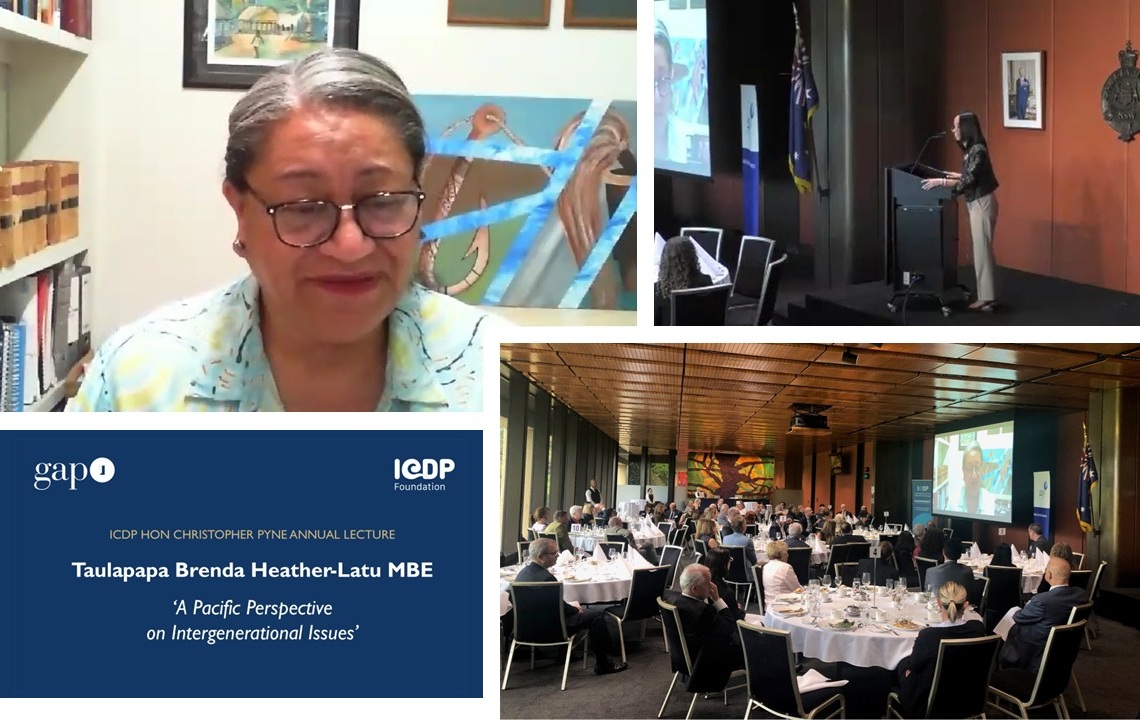
International Centre for Democratic Partnerships (ICDP) Hon Christopher Pyne Lecture
A Pacific Perspective on Intergenerational Issues
This is the edited transcript of the presentation by Taulapapa Brenda Heather-Latu MBE, former Attorney-General of Samoa (1997-2006), Partner at Latu Lawyers and Director of ICDP, at the Global Access Partners (GAP) Intergenerational Summit on 7 November 2025 at NSW Parliament House.
Talofa lava
i le paia ma le mamalu
o ē ua auai i lenei fa’amoemoe.
I le alofa ma le agalelei a le Atua.
I have greeted you and honoured you in my language, and in doing so must also acknowledge with honour and respect the Gadigal people of the Eora Nation as the traditional owners of the land on which we meet. I pay homage to elders past and present.
I acknowledge the graciousness of the hosting member, the Hon Anthony Roberts MP, and also the Premier of New South Wales, the Hon Chris Minns MP, whose support has allowed us to gather in this hallowed and historic place.
May I thank Zha [Agabe-Granfar] for her very kind introduction as the founder and executive director of Verge from PNG and an ambassador for ICDP. I thank you, and in addressing you today, I offer my gratitude to Global Access Partners, and in particular Catherine Fritz-Kalish, GAP’s co-founder and managing director, for convening a summit on a subject which impacts us all.
I am grateful for the privilege of delivering the inaugural Hon Christopher Pyne Annual Lecture to such an esteemed audience.
My address today seeks to draw together some strands about how Pacific peoples have lived and survived through the ages, which may be of relevance to the conversations you are having and to the speeches you heard earlier this morning.
Land, family and faith are the fundamental reference points for many communal societies in the world, and they are still actively lived and observed by the many islands and cultures of the Pacific. These values are now being practised here in Australia through migration and birth. According to your 2021 census, 337,000 people identify as being of Pacific heritage and reside in Australia. Our reference points and core values are therefore still practised within the Pasifika communities living here.
These cultural imperatives continue the traditions of our ancestors at home and in the places where we travel to work, live and care for our families. As with the traditional owners of this land, we share a belief that our identity flows from the lands we own or once occupied, and that their spirit and history still enfold us. Our languages hold the key to understanding our lineages, and the family who remain living in our home islands become the custodians of our customary lands and the continuing representatives of our families within our villages.
When I use the term Pasifika, I use it as a broad term to describe people of the Pacific or people of Pacific heritage.
Let us look at context.
A typical Samoan family would consist of grandparents and, if you are very lucky, a great-grandparent. Their adult children, one of whom would be your parent. The spouses of those adult children, and their children, which is one of you, and then eventually their spouses, their children and their children’s children.
Each family would live in an open home known as a fale (or traditional oval or round open wooden structure with poles) with surrounding land for crops, or land set aside for your family to cultivate yams and taro in the hills or the hinterlands. And you would fish for food. Life would be subsistence.
Each family would have a house and land. Each village would have between 10 and 40 families, led by their family chiefs, respected elders, and include the religious ministers of the four to six churches in every village.
Our elders would be the font of all wisdom, and respect and honour would be shown to them. They would be served first in everything, including food. They would lead and be responsible for the family and also take leadership roles in their churches. They would command the highest honour, respect and affection from members of the family as well as the village and district.
Samoa has over 330 villages. A group of villages, (usually between ten and twenty-five), forms a district, usually geographically but also historically bound together. There are 51 districts across the two main islands and two smaller islands of Samoa. This is the social context within which our country continues to operate, although urban areas have become very popular as people move into the capital Apia for schools, jobs and opportunities.
Samoan family units support each member and care for each other, including the elderly and all the children of the family, as a reflection of cultural and social expressions of love, respect and responsibility.
Most Samoan families now have members who left for New Zealand during the early migrations of the 1950s and 60s, and to Australia from New Zealand in the 1970s through the 1990s. More recently, children, nephews and nieces, and parents have migrated under various labour mobility schemes. Our family members outside Samoa send money to support those at home through regular payments, (often fortnightly or monthly), covering living expenses or special events. These can include monetary gifts for funerals, donations to the church, building a modern walled house, buying a shop or taxi, or developing land. These funds allow those who have left to continue supporting their families who remain at home.
Eventually, their children replace their parents once they retire in Australia and New Zealand, continuing that support. There was once a view that when the first migrant generation passed away, remittances home would reduce significantly. In fact, they have risen, driven by renewed engagement among young New Zealand, Australian and US-born Samoans with their homelands.
Think of the excitement around the recent rugby league games in Brisbane, and the big game happening on Sunday in Sydney between New Zealand and Samoa. Some of you will know a Samoan person or have worked with someone who has recently been bestowed a chiefly title and given a long name,( full of vowels and hard to pronounce). This reflects the re-engagement of the diaspora and their interest in their home island countries.
Remittances are a significant part of Pacific economies. In 2022, according to G20 statistics, USD 6.5 billion was remitted overseas from Australia, making it the 25th highest remittance-sending country in the world. The main recipient countries were China, India, Vietnam and the Philippines. Remittances contribute substantially to the economies of Tonga, Samoa and Fiji. They make up 24% of Tonga’s GDP, 13%of Samoa’s, 20% of Vanuatu’s and 18% of Kiribati’s.
When we talk about intergenerational issues, developed countries such as Australia and New Zealand must focus on the changes being driven by rapidly shifting demographics. This has hastened the need to assess how we live our lives. You have heard today of the innovation and thought being invested in planning, and the enormous role which your public sector and private thought leaders are contributing. It has suddenly become time to prepare for dynamic and inevitable shifts in the makeup of our societies. It touches all of us as we consider how we care for our families, parents and grandparents.
There is now a pressing need to reconsider and create social policies for caring for people, especially those who are unprepared to live longer lives untethered from any community and detached from personal support, but who will need someone to ‘catch them’ from poverty and destitution.
In Pacific nations, speaking broadly, Pasifika people have relied largely on their families to care for elderly relatives, people with physical or mental health needs and those who are chronically ill. Where public services are available overseas, then they seek that support, often in their capacity as Australian or New Zealand or US residents or citizens.
The source of remittances sent to the Pacific is the hard work of our family members living and working abroad, with their primary purpose being for the care, support and love of their family, villages and churches.
To live successfully in intergenerational relationships, generations of Pacific people have found that certain traits are necessary in order to live peacefully, even communally. These traits include patience and forbearance; the need for reconciliation between family members over disputes or differences; having a means to resolve disputes quickly; having a mutual covenant to care for, love and respect household members; placing God’s love, mercy and grace at the heart of all relationships, and believing that you are stronger together than apart.
Faith in God is foundational in many Pacific island states such as Samoa, and continues to play a practical role in shaping how we treat and serve one another. It applies as the gold standard for living.
Does it always work? In case you are lulled into thinking of swaying palms and pristine sands, of course not. But at least the means exist to work things out. And ultimately, for many, Faith brings hope, no matter what the circumstances and how desperate the times.
The Pacific has watched tensions build in and around us in the past decade, as powerful influences converge seeking connection and loyalty from us as individual Pacific states and territories. We face the continued loss of land beneath our feet with the ever-intrusive sea, as we confront what the Pacific Islands Forum has described as the greatest existential threat facing the Blue Pacific: climate change.
Pacific leaders have been very active on the world stage in defining the dangers and threats we face as small island states. The Blue Pacific 2050 Strategy aims for a sustainably managed, peaceful, safe and secure Blue Pacific continent. The earlier Boe Declaration seeks to reduce and mitigate risks to regional security. Australia has been pivotal in supporting Pacific nations to implement its requirements.
In September this year, 2025, our leaders launched the Ocean of Peace Declaration in the Solomon Islands during their annual meeting. This statement affirms that Pacific peoples have a right to peace, a right to a Pacific Ocean free from conflict, and an ocean where respect and cooperation among nations should prevail. Peace in the Pacific is a cry. No, actually, it is a demand from the people of the Pacific.
In summary, the people of the Pacific have benefited greatly from relationships with surrounding nations, especially Australia, which has been a benevolent host to our people and a generous development partner in fulfilling our aspirations at home. Our contributions to this land echo from academia and the arts, to the sports grounds, classrooms, farms, businesses and factories of this nation. We can contribute so much more with intergenerational living, as we have experience and knowledge to share at this decisive moment in history.
We are drawn to share with our neighbours because of our faith, our care for community and the need to counterbalance conflict, fear, anger and uncertainty. That counterbalance is hope.
From that vantage point, I believe we must keep whispering to ourselves words such as these:
‘Fix your thoughts on what is true and honourable and right and pure and lovely and admirable. Think about the things that are excellent and worthy of praise. Keep putting into practice all you have learned and received from me, everything you have heard from me and saw me doing, then the God of peace will be with you.’ – Philippians 4:6–9
Thank you for your time and attention this afternoon.
May you all be blessed.
Soifua ma ia manuia. Farewell and thank you.


