



Running a business is often discussed in terms of revenue, profit and sales. Yet for many entrepreneurs and small business owners across the Pacific, financial strength is equally about sustainability, the ability to pay yourself fairly, and supporting family and community without putting the business at risk.
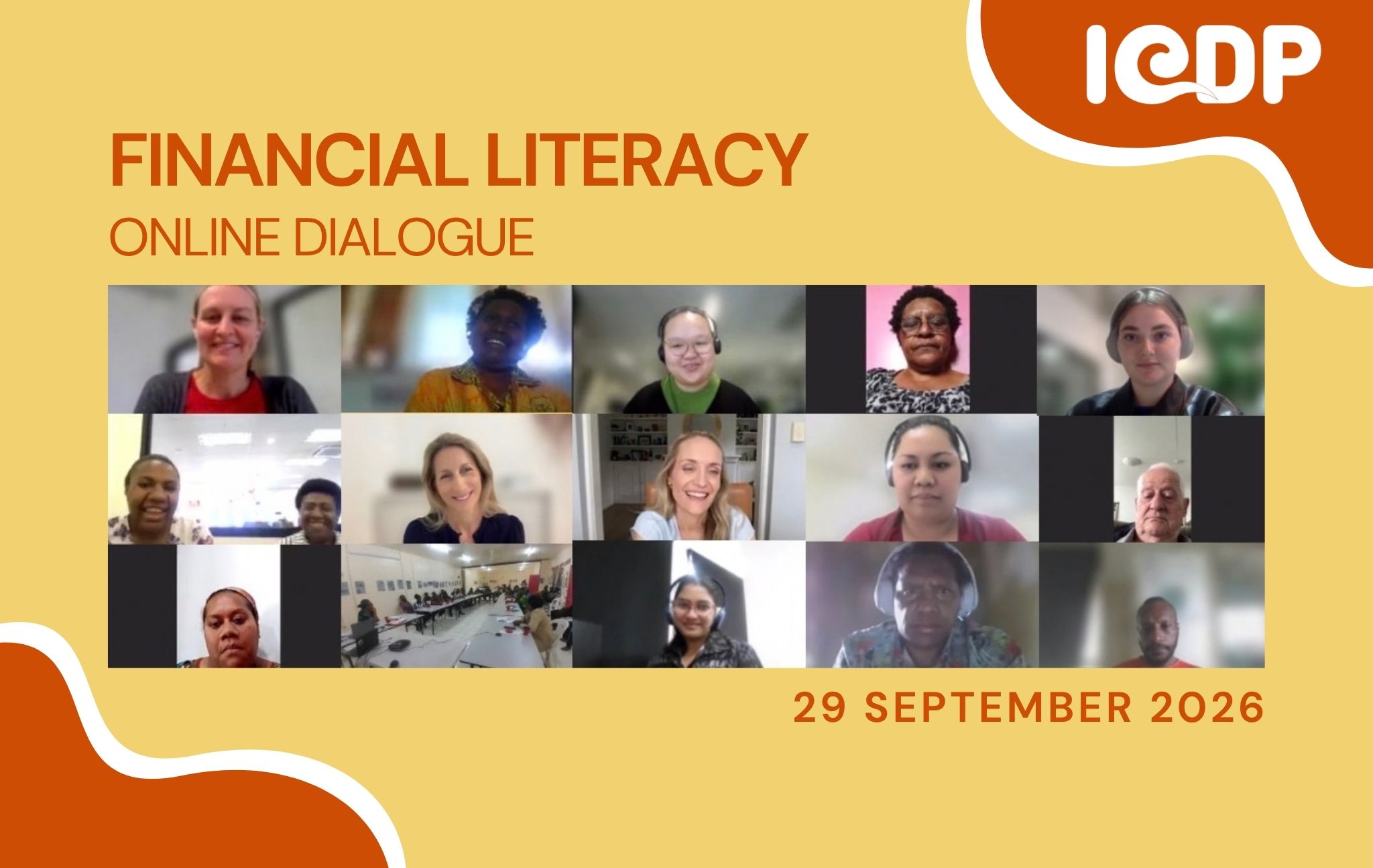
On 29 September 2026, ICDP convened the second online Dialogue in its Financial Literacy series, titled ‘Money Smart, Business Strong’. The session was co-facilitated by Georgina Benson, ICDP Papua New Guinea Hub Coordinator and Founder of Mohone Coffee, and Catherine Fritz-Kalish AM, Director of ICDP.
The event welcomed 76 entrepreneurs and small business owners, community leaders, finance professionals, cooperative board members and other community members from Papua New Guinea, Fiji, Australia and the Solomon Islands. This included 37 participants who joined in person at the Coffee Authority Training Centre in Goroka, Papua New Guinea, hosted by Georgina.
The Dialogue featured Betsy Westcott, an experienced financial adviser, mortgage broker and money coach, who shared practical insights on pricing and paying yourself fairly, managing cash flow and seasonality, sustainable business growth, and balancing business, family and community responsibilities. Following Betsy’s presentation, the session continued with a Talanoa-style discussion.
One of the strongest messages to emerge from the discussion was that a financially fit business is not necessarily about scale, rather sustainability. A successful business is one that can cover costs, pay its owner, with-stand unexpected shocks and build longer-term security.
Participants discussed the challenges of pricing, as Betsy highlighted that many business owners price only to cover materials and direct expenses and often overlook the value of their own time and a margin for profit. A simple approach was suggested: materials, plus fair payment for the owner’s labour, plus profit, tested against what the market will bear. The conversation also covered how to set a fair hourly rate for oneself by drawing on local industry references, the cost of employing someone else to do the work, and the owner’s own cost of living.
The Dialogue also explored how to manage cashflow in seasonal businesses such as agriculture, coffee and tourism. Rather than spending everything during high-earning periods, a portion should be retained to build a buffer that can carry the business and its owner through quieter months. Simple systems can help, from separate jars or envelopes in informal businesses to separate bank accounts in formal ones, combined with a regular check-in on what came in, what went out and whether the business is on track.
The Dialogue also covered different ways to sustainably grow a business and the trade-offs involved. Retaining profit, bringing in a partner and borrowing each offer different combinations of speed, control, cost and risk. Decisions should be deliberate rather than reactive and support can be obtained through peer learning, community networks, government services and financial institutions.
The Dialogue also acknowledged that family and community obligations are part of the business environment for many Pacific entrepreneurs. While generosity and mutual support are central to community life, repeatedly drawing on a business can undermine its ability to continue. Protecting the business is not inconsistent with supporting others and a financially resilient enterprise is better placed to provide employment, support family and contribute to the community over the long term.
The strong participation and engagement throughout the Dialogue reflects the growing strength of ICDP’s regional network and the invaluable role played by local hubs and community leaders. It also demonstrates the continuing demand for accessible and culturally informed financial education across Pacific communities. Strong interest was expressed in continuing the discussion on Financial Literacy through future sessions.
After the conclusion of the formal online dialogue session, Georgina continued the conversation with the in-person participants at the Coffee Authority Training Centre in Goroka. Georgina translated the presentation slides and key concepts into Pidgin which enhanced engagement and comprehension with the in-person participants.
A comprehensive report of the Dialogue will be released shortly.

